Government Pledges Fair Revenue Sharing for New Local Councils
By Abdul Rahman Bah
FREETOWN — The Government of Sierra Leone has assured that the establishment of new localities will be supported by an equitable fiscal framework designed to promote grassroots development without undermining the financial viability of existing local councils.
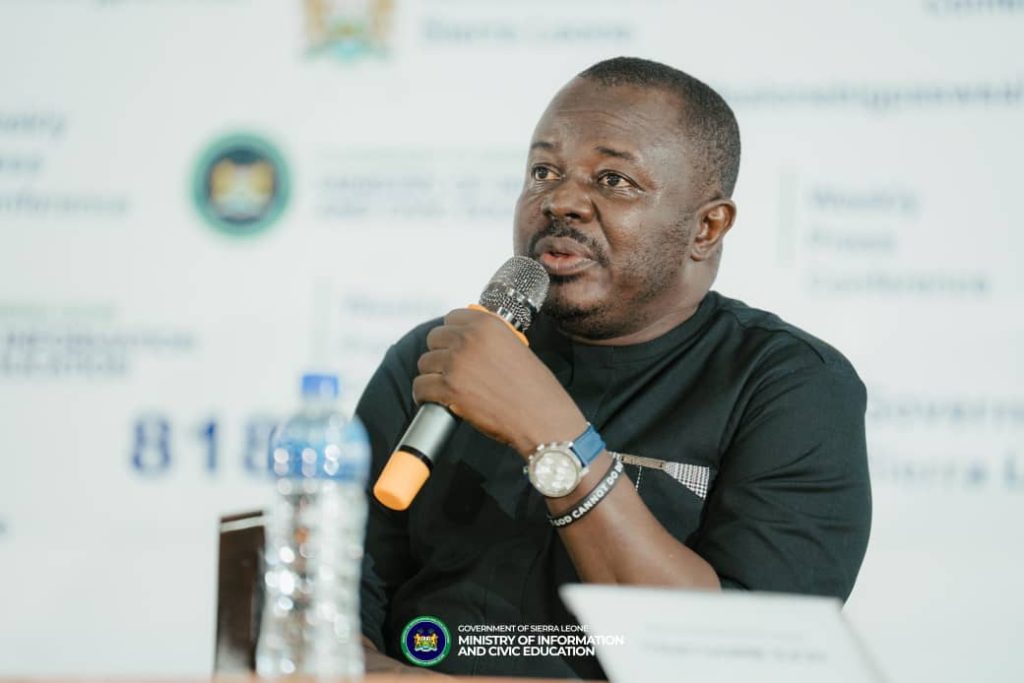
Director of the Decentralisation Secretariat, Alex Bonapha, gave the assurance during the Government’s Weekly Press Conference held on October 13, 2026, at the Miatta Civic Centre in Freetown. He outlined the rationale, benefits and economic opportunities associated with the establishment of councils for York, Zimmi, Panguma and Bandajuma.
Speaking on the theme, “Redistricting and the Establishment of New Localities in Sierra Leone: Rationale, Benefits and Opportunities for Improved Local Governance,” Bonapha said the initiative was intended to bring governance closer to the people, improve public service delivery and enable communities to benefit more directly from resources generated within their areas.
He explained that the new councils would have greater opportunities to mobilise and retain locally generated revenue to finance development projects and respond to the specific needs of their communities.
Using York as an example, Bonapha noted that revenue from sand mining and resort fees, which previously accrued to Waterloo, could be retained within the new locality to support local development priorities.

Zimmi, he said, could also benefit from its strategic position as a gateway and border town, creating opportunities to stimulate economic activity, expand revenue generation and improve livelihoods for residents.
However, Bonapha acknowledged that redistricting could affect the revenue base of existing councils, making it necessary for the government to establish a mechanism that balances the interests of both the new and existing local authorities.
He disclosed that the government was developing a comprehensive fiscal rebalancing framework to ensure that councils such as Waterloo and Pujehun remained financially viable while the newly established councils developed their revenue-generating capacity.
“This has advantages, of course. It has opportunities,” Bonapha said, emphasising the potential benefits of the initiative while underscoring the importance of managing the transition sustainably.
He added that similar considerations were being made for Panguma and Bandajuma to ensure that the new local authorities could effectively discharge their responsibilities without creating undue financial pressure on existing councils.
The proposed fiscal arrangement is expected to play a critical role in determining how resources are distributed following the creation of the new localities. An equitable framework would help ensure that the expansion of local governance translates into improved service delivery and development opportunities across affected communities.

The redistricting exercise forms part of the government’s broader decentralisation agenda, which seeks to strengthen local governance, expand access to public services and promote more inclusive development.
Ultimately, the effectiveness of the new councils will depend on their ability to mobilise revenue, manage public resources transparently and efficiently, and translate increased local authority into tangible improvements in the lives of citizens. The proposed fiscal rebalancing mechanism will therefore be central to ensuring that the creation of new councils benefits their residents without weakening the institutions already responsible for delivering local services.