Juldeh Sowe Promises Stronger Pulaaku International Leadership
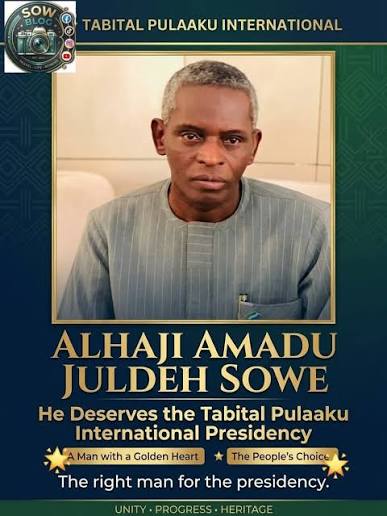
Alhaji Amadu Brakindo Juldeh Sowe has formally declared his intention to contest for the presidency of Tabital Pulaaku International, promising to champion unity, cultural preservation, institutional renewal, international cooperation and economic empowerment if elected to lead the global Pulaaku organisation.
The declaration, which took place on August 29, 2026, at the headquarters of Tabital Pulaaku International in Bamako, Mali, marks the official beginning of his campaign to take over the leadership of the organisation and advance what his supporters describe as a new vision for the Pulaaku community.
Juldeh Sowe’s declaration comes at a time when members and supporters of Tabital Pulaaku International are increasingly calling for stronger cooperation, effective leadership and renewed efforts to preserve the cultural heritage and identity of Pulaaku communities across Africa and beyond.
In presenting his candidacy, Alhaji Amadu Brakindo Juldeh Sowe described the organisation as an important platform for bringing together Pulaaku communities, promoting their shared values and traditions, and creating opportunities for members to participate meaningfully in their social and economic development.
He argued that the future of Tabital Pulaaku International must be built around collective responsibility, inclusion and service, rather than leadership being viewed simply as an opportunity to occupy a position of authority.

According to his campaign vision, leadership must be measured by its ability to bring people together, respond to their concerns and create lasting opportunities for future generations.
A Vision for a Stronger Pulaaku Community
At the heart of Juldeh Sowe’s campaign is a call for greater unity among Pulaaku communities scattered across different countries and continents.
He believes that despite geographical boundaries, differences in national circumstances and generational changes, Pulaaku people remain connected by a common cultural heritage, traditions and values.
His campaign therefore seeks to strengthen cooperation among national chapters of Tabital Pulaaku International and establish stronger links between communities in Africa, Europe, the Middle East and other parts of the world.
The proposed approach is intended to create a more coordinated organisation capable of speaking with a stronger voice on issues affecting its members while maintaining respect for the cultural traditions that define Pulaaku identity.
Juldeh Sowe’s supporters say his candidacy presents an opportunity to promote reconciliation, cooperation and institutional renewal while encouraging members from different backgrounds to work together towards common objectives.
His campaign message, “One People, One Vision, One Future,” captures what he describes as the need for the organisation to move forward as a united family.
Preserving Pulaaku Culture and Identity
Cultural preservation also occupies a prominent place in Juldeh Sowe’s proposed programme.
He maintains that modernisation and cultural preservation should not be treated as competing objectives, but should instead complement each other.
His vision is to ensure that Tabital Pulaaku International remains firmly rooted in its traditional values while adapting to the realities of a rapidly changing world.
He is particularly advocating greater involvement of young people in cultural activities and decision-making, arguing that the survival of Pulaaku traditions depends largely on the ability of the younger generation to understand, appreciate and carry forward its cultural heritage.
The campaign also seeks to encourage stronger participation by traditional leaders, women, professionals, intellectuals, entrepreneurs and community activists.
According to the vision presented by his campaign, these groups all have important roles to play in preserving the identity of the Pulaaku people and strengthening the organisation.

Youth and Women at the Centre
Juldeh Sowe’s proposed leadership agenda also places emphasis on creating greater opportunities for women and young people.
His campaign argues that young people represent an important resource for the future of the Pulaaku community and should therefore be given meaningful opportunities to contribute to the organisation’s development.
The proposed approach includes encouraging young professionals, entrepreneurs and intellectuals to become more actively involved in community initiatives and leadership structures.
Women, too, are expected to play a greater role under his vision, particularly in community development, education, entrepreneurship and cultural preservation.
The campaign believes that broader participation would help Tabital Pulaaku International benefit from the skills, experience and creativity available across its diverse membership.
Economic Empowerment
Economic empowerment is another major component of Juldeh Sowe’s campaign.
Beyond cultural and social activities, he wants Tabital Pulaaku International to become a stronger platform for promoting economic opportunities among its members.
His campaign proposes initiatives aimed at supporting entrepreneurs, professionals, women, young people and community-based enterprises.
The objective, according to the vision, is to enable members to contribute more effectively to economic development while creating opportunities that can improve livelihoods within Pulaaku communities.
Juldeh Sowe’s supporters believe that cultural development cannot be separated from economic empowerment and that a stronger economic base would enable communities to invest more in education, youth development, cultural preservation and social welfare.
Strengthening International Cooperation
Another key element of his agenda is international cooperation.
Given the widespread presence of Pulaaku communities across national borders, Juldeh Sowe believes Tabital Pulaaku International must strengthen its partnerships and communication with national chapters and community organisations around the world.
His vision calls for increased dialogue and collaboration among chapters, with the aim of sharing experiences, identifying common challenges and developing joint initiatives.
The campaign also seeks to position Tabital Pulaaku International as a more effective international organisation capable of responding to the changing needs of its members.
Leadership Through Service
For Juldeh Sowe, the question of leadership is closely linked to service.
His campaign maintains that occupying the presidency should not be an end in itself, but an opportunity to serve the people and strengthen the organisation.
He has therefore presented himself as a candidate committed to responsibility, transparency, accountability and inclusive leadership.
His vision calls for an organisation where members feel represented and empowered to contribute to decision-making and where leadership remains accessible to the wider community.
The campaign’s leadership philosophy is reflected in its message: “Leadership for Unity, Vision for Progress, Service to the People.”
Building a More Inclusive Organisation
Juldeh Sowe is also advocating an organisation that can bring together people from different generations and professional backgrounds.
His campaign recognises the important role of traditional leaders in preserving cultural values while also stressing the need to embrace professionals, academics, entrepreneurs, young people and members of the diaspora.
The proposed inclusive approach is intended to bridge generational and geographical differences and create a common platform where members can contribute according to their experience and expertise.
According to his supporters, Tabital Pulaaku International requires leadership capable of balancing respect for tradition with the demands of modern governance and development.

The Road to the Presidency
With his declaration in Bamako, Alhaji Amadu Brakindo Juldeh Sowe has formally entered the race for the presidency of Tabital Pulaaku International.
His campaign is expected to focus on engaging national chapters, community leaders and members on his vision for the organisation as the electoral process progresses.
The contest is likely to generate broader discussions about the future direction of Tabital Pulaaku International, including questions of leadership, cultural preservation, youth participation, women’s empowerment, institutional strengthening and economic development.
For Juldeh Sowe and his supporters, however, the campaign is about more than winning an election.
They describe it as an opportunity to build a stronger, more united and forward-looking Pulaaku organisation capable of preserving its identity while responding to the social, economic and cultural challenges confronting its communities.
The Bamako declaration has therefore been presented as the beginning of a broader movement centred on unity, service, progress and development.
As the campaign gathers momentum, Juldeh Sowe is calling on members of Tabital Pulaaku International to embrace a shared vision and work collectively towards an organisation that gives every member a meaningful voice.
His message remains anchored on four central principles: one people, one identity, one vision and one united future.
With the slogan “One People, One Vision, One Future,” Alhaji Amadu Brakindo Juldeh Sowe is seeking to convince members that a renewed Tabital Pulaaku International can become a stronger force for cultural preservation, community development, international cooperation and economic empowerment.
The race for the presidency has now begun, and Juldeh Sowe’s campaign is placing unity, service and a renewed sense of collective purpose at the centre of his bid to lead Tabital Pulaaku International.