Inside Freetown’s Relentless Fight Against Flood Disaster
By Abdul Rahman Bah
Every rainy season in Sierra Leone brings fear, uncertainty, and anxiety to thousands of families living in vulnerable coastal communities. But in the densely populated settlements of Portee and Rokupa in eastern Freetown, survival has become more than a seasonal challenge. It has evolved into a daily reality shaped by resilience, sacrifice, endurance, and an unbreakable spirit of community solidarity.
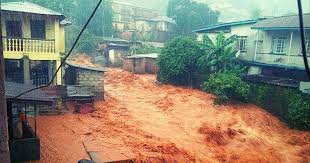
Whenever heavy rains pound the capital city, floodwaters quickly sweep through narrow streets and overcrowded settlements, invading homes built from rusted zinc sheets, wood, mud blocks, and broken concrete. Families often wake up in the middle of the night to rising water levels creeping through their doorways. Children sleep on soaked mattresses, cooking utensils float in muddy water, and frightened residents scramble to rescue whatever little property they can before the floods consume everything.
For many residents, however, leaving is not an option.
Despite the recurring destruction, generations of families continue to remain in these communities because they represent more than just settlements. They are places where livelihoods, memories, friendships, and survival are deeply rooted.
Recent climate resilience studies conducted in Freetown identify Portee and Rokupa among the most flood-prone and environmentally vulnerable communities in Sierra Leone. Experts attribute the worsening floods to poor drainage systems, rapid urban overcrowding, environmental degradation, and rising sea levels linked to climate change.
Researchers also found that during major flood disasters, many affected families receive little or no immediate formal assistance, forcing residents to rely heavily on neighbours, relatives, and community support systems to survive.
For 42-year-old fish seller Mariama Kamara, every rainy season feels like a painful test between protecting her children and preserving the small business that keeps her family alive.
Last August, floodwaters reportedly entered her tiny one-room house before dawn after hours of heavy rainfall. In desperation, she placed her youngest child inside a plastic basin to keep him above the rising water while her older daughter rushed to carry their schoolbooks and clothing to a neighbour’s house located on slightly higher ground.
“We lost almost everything,” Mariama said softly while standing beside a damaged drainage path now clogged with garbage and stagnant water.
“But I cannot leave because this is where I survive,” she added.
Her story mirrors the experiences of hundreds of vulnerable families living across Sierra Leone’s coastal communities where flooding continues to threaten homes, businesses, education, and public health.
Climate and urban resilience reports indicate that repeated flooding is now disrupting livelihoods and worsening poverty in many informal settlements across Freetown. Schools are often damaged or temporarily shut down after severe rainfall, forcing children out of classrooms for days and, in some cases, weeks.
Health experts also warn that stagnant floodwater and poor sanitation conditions increase the risk of waterborne diseases, infections, and other public health emergencies, particularly among children and the elderly.
Yet amid the hardship and uncertainty, many communities continue to demonstrate extraordinary resilience and collective action.
In both Portee and Rokupa, young volunteers regularly organize clean-up exercises to clear blocked gutters and drainage channels before major storms arrive. Women’s groups have also established informal support systems that provide emergency food assistance and temporary shelter for displaced families during severe flooding.
Local youth groups, meanwhile, increasingly rely on mobile phones, social media platforms, and word-of-mouth communication to warn residents whenever water levels begin to rise dangerously.
In one narrow alleyway in Rokupa, residents recently constructed a temporary flood barrier using sandbags, stones, discarded timber, and broken concrete after repeated flooding destroyed several nearby homes.
Remarkably, the initiative was not led by government authorities or international organizations, but by unemployed young men determined to protect elderly residents and vulnerable families living close to the shoreline.
Community leaders say such local efforts, though limited in resources, have helped save lives during recent storms.
Climate experts continue to warn that worsening rainfall patterns, environmental degradation, and rising sea levels could place even greater pressure on vulnerable coastal settlements in the coming years.
But for many residents of Portee and Rokupa, resilience has already become a permanent part of everyday life.
Even after devastating floods, children still gather to play football on muddy streets once the rain subsides. Fishermen continue heading out to sea before sunrise despite damaged homes and uncertain weather conditions. Mothers reopen small market stalls after losing goods to floodwater because survival demands persistence.
In communities too often associated with tragedy and disaster, many residents continue to choose hope over surrender.
Across Sierra Leone, survival is no longer simply about enduring poverty, floods, or climate disaster. Increasingly, it is about ordinary citizens refusing to allow hardship, displacement, and suffering to erase their dignity, humanity, and determination to keep moving forward.