NatCA Celebrates Legacy, Embraces Innovation
FREETOWN, 5 August 2026 – The National Communications Authority (NatCA) has marked two decades of regulating Sierra Leone’s communications sector with a bold pledge to drive the country’s next phase of digital transformation, as Government challenged stakeholders to ensure that the benefits of technology reach every citizen, regardless of where they live.
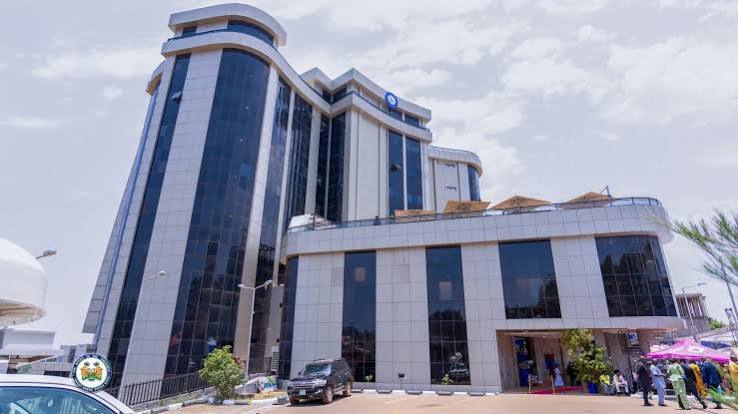
The anniversary celebration, held on Monday, 3 August 2026, at the NatCA Tower in Southridge, IMATT, Freetown, brought together Government ministers, Members of Parliament, former leaders of the institution, telecommunications operators, development partners, regulators, private-sector representatives, staff and members of the media to reflect on twenty years of progress while outlining an ambitious vision for the future.
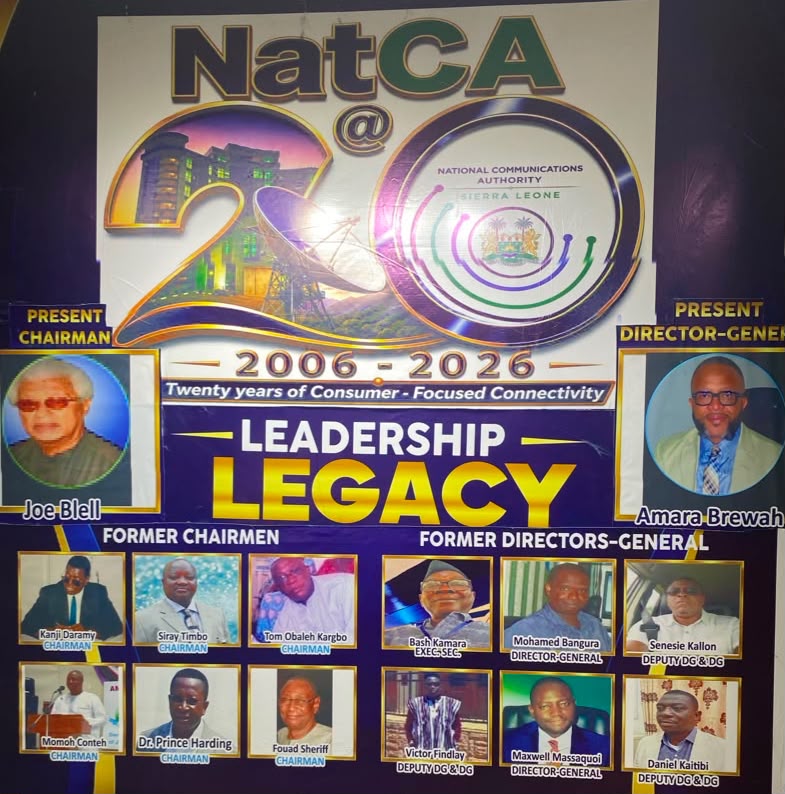
Held under the theme, “Twenty Years of Consumer-Focused Connectivity,” the event celebrated the Authority’s evolution from a telecommunications regulator into a modern communications authority overseeing mobile services, internet connectivity, broadcasting, satellite communications and emerging digital technologies.
Government Calls for the Next Digital Leap

Delivering the keynote address, Minister of Communication, Technology and Innovation, Haja Salima Monorma Bah, applauded NatCA’s achievements over the past two decades but emphasized that Sierra Leone’s digital journey remains unfinished.
She revealed that although mobile network coverage now extends to approximately 96 percent of the country’s population, internet usage remains significantly lower at around 42 percent, exposing a major digital divide that threatens to limit economic growth and social inclusion.
“The next chapter of Sierra Leone’s digital transformation cannot simply be about expanding network coverage,” the Minister said. “It must be about ensuring that every Sierra Leonean can actually use digital services in meaningful ways.”
According to her, the country’s communications infrastructure has expanded rapidly over the years. Sierra Leone’s national fibre-optic backbone now reaches 14 of the country’s 16 districts, while new licensing models and satellite communications have significantly increased access to telecommunications services across the country.
However, she stressed that infrastructure alone is insufficient.
The Minister identified affordability, access to smartphones and digital devices, digital literacy, network reliability and quality of service as the next major priorities if Sierra Leone is to fully embrace the digital economy.
She urged telecommunications companies to place greater emphasis on customer satisfaction by responding quickly to complaints, communicating transparently during service interruptions and ensuring consumers receive reliable services that justify the money they spend.
“The next twenty years should be about bridging the usage gap, making services more affordable and ensuring that citizens receive better quality of service,” she declared.
She further called for stronger collaboration between Government, Parliament, regulators, telecommunications operators, civil society organisations and development partners to accelerate the country’s digital transformation agenda.
From Telephone Booths to Smartphones
Earlier, NatCA Director General Amara Brewah reflected on the remarkable transformation of Sierra Leone’s communications landscape since the regulator was established in 2006.
Describing the anniversary as both a celebration and a moment of reflection, Brewah painted a vivid picture of how dramatically communications have changed over the past two decades.
He recalled an era when making an international telephone call often required travelling to Freetown, waiting patiently in long queues and depending on expensive collect-call services.
“For many young Sierra Leoneans today, that reality seems unimaginable,” he observed.
“A child born when our regulator was created in 2006 is today a young adult who has grown up in a world of smartphones, mobile banking, online learning, video calls, digital commerce and instant global communication.”
He noted that the communications revolution has fundamentally changed the way Sierra Leoneans conduct business, access education, receive healthcare, communicate with loved ones abroad and participate in national development.

Evolution of the Regulator
Tracing the institution’s history, Brewah explained that Parliament established the National Telecommunications Commission (NATCOM) through the Telecommunications Act of 2006 to regulate what was then a rapidly expanding telecommunications industry.
Subsequent amendments to the law in 2009 significantly broadened the Commission’s responsibilities as technology evolved.
He identified the landing of the Africa Coast to Europe (ACE) submarine fibre-optic cable in 2013 as one of the most transformative developments in Sierra Leone’s digital history, connecting the country directly to global high-speed broadband networks and opening new opportunities for internet expansion.
A further milestone came with the passage of the National Communications Authority Act in 2022, which transformed NATCOM into NatCA, giving the institution a wider, technology-neutral mandate capable of regulating telecommunications, broadcasting, internet services and emerging digital innovations under one framework.
Communications Sector Records Massive Growth
Providing an overview of the industry’s growth, Brewah disclosed that Sierra Leone’s communications sector has expanded dramatically over the past twenty years.
According to him, the country now boasts four mobile network operators, one mobile virtual network operator, 32 licensed internet service providers, 21 digital television stations, 222 FM radio stations and three open-access infrastructure providers.
He further revealed that mobile voice subscriptions have climbed to approximately 8.66 million, while mobile data subscriptions stand at about 3.78 million, reflecting increasing public reliance on digital communications.
NatCA has also introduced several important regulatory reforms, including mobile money interoperability, stronger SIM registration systems, harmonised short codes, regional roaming arrangements and regulatory frameworks for satellite communications.
The Authority has equally strengthened quality-of-service monitoring, undertaken market and consumer research and issued trial licences for the rollout of fifth-generation (5G) mobile technology.
Digital Progress Must Improve Lives
Despite highlighting these achievements, Brewah stressed that statistics alone cannot measure success.
He argued that the real impact of communications technology should be judged by its ability to improve people’s lives.
For farmers, this means obtaining market prices through mobile phones before transporting produce.
For traders, it means receiving instant digital payments instead of carrying cash.
For students, it means accessing educational resources online regardless of where they live.
For entrepreneurs, it means building businesses that can reach customers far beyond their local communities.
“Our responsibility goes beyond regulating networks,” Brewah said. “We are helping to build the foundation of Sierra Leone’s digital economy.”
Addressing recurring public complaints over dropped calls and poor network quality, the Director General assured consumers that NatCA continues to monitor operators closely.
He explained that while the Authority possesses enforcement powers, sanctions must follow legally established monitoring and investigation procedures to ensure fairness and regulatory certainty.
Preparing for Artificial Intelligence and 5G
Looking ahead, Brewah said NatCA is already preparing for the next technological revolution.
He identified artificial intelligence (AI), 5G networks, cloud computing, satellite broadband, cybersecurity, digital identity systems and the Internet of Things (IoT) as technologies that will fundamentally reshape Sierra Leone’s economy over the coming years.
He pledged that NatCA would continue working towards a future where no Sierra Leonean is excluded from the opportunities created by digital transformation because of geography, gender or income.

Industry Leaders Back NatCA’s Vision
Acting NatCA Board Chairman Paul Squire said stronger, more agile regulation will become increasingly important as digital technologies evolve.
He challenged management and staff to raise performance standards, saying that if the institution currently performs at 60 percent, it should strive immediately to reach 90 percent.
Leaders of the country’s major telecommunications companies also reaffirmed their commitment to supporting Sierra Leone’s digital ambitions.
Orange Sierra Leone Chief Executive Officer Aïcha Touré said telecommunications companies continue to make substantial contributions to national development through investments in infrastructure, taxes, licence fees, employment creation and financial inclusion.
She highlighted Orange Money’s growing role in expanding access to financial services for thousands of Sierra Leoneans.
QCell Sierra Leone Chief Executive Officer Karthik Jayamani praised NatCA for maintaining industry discipline and protecting consumer interests.
Using a football analogy, he described NatCA as the referee, operators as the players and consumers as the supporters whose interests should always come first.
He noted that while competition has greatly improved customer choice, operators face increasing financial pressure because they must continue investing in new technologies even before recovering previous investments.
Africell Sierra Leone Chief Executive Officer Shadi Gerjawi called for continued cooperation between the regulator and operators, saying collaboration remains essential for sustainable sector growth.
He pointed to rising fuel prices as one of the industry’s biggest operational challenges, explaining that telecommunications companies continue to rely heavily on diesel generators to power network infrastructure in areas without reliable electricity.
Honouring Two Decades of Service
The anniversary celebration concluded with awards recognising former Directors General, retired staff members and long-serving employees whose dedication has contributed to the Authority’s development over the past twenty years.
Tributes were also paid to deceased officials and employees whose service helped shape Sierra Leone’s communications industry.
Guests later witnessed the unveiling of NatCA’s 20th anniversary logo, the cutting of a commemorative cake and a guided tour of the Authority’s facilities.
As Sierra Leone embraces artificial intelligence, digital finance, smart technologies and next-generation broadband, speakers agreed that NatCA’s role will become even more critical in ensuring that innovation is accompanied by effective regulation, consumer protection and inclusive access.
After twenty years of overseeing one of the country’s fastest-growing sectors, the Authority says its greatest challenge now is not merely connecting Sierra Leone—but ensuring that every citizen can fully participate in the digital future.